What would you give for one of the old yellow streetcars
rocking towards you again through the thick snow?
What would you give for the feeling of joy as you climbed
up the three iron steps and took your place by the cold window?
Oh, what would you give to pick up your stack of books
and walk down the icy path in front of the library?
What would you give for your dream
to be as clear and simple as it was then
in the dark afternoons, at the old scarred tables?
- Gerald Stern
Black Sea
One clear night while the others slept, I climbed
the stairs to the roof of the house and under a sky
strewn with stars I gazed at the sea, at the spread of it,
the rolling crests of it raked by the wind, becoming
like bits of lace tossed in the air. I stood in the long,
whispering night, waiting for something, a sign, the approach
of a distant light, and I imagined you coming closer,
the dark waves of your hair mingling with the sea,
and the dark became desire, and desire the arriving light.
The nearness, the momentary warmth of you as I stood
on that lonely height watching the slow swells of the sea
break on the shore and turn briefly into glass and disappear . . .
Why did I believe you would come out of nowhere? Why with all
that the world offers would you come only because I was here?
- Mark Strand
Elton John - "My Father's Gun"
Exclusion
It’s a relief to drift past lovely things that exclude me.
It would take a machete to open hedges of flaming xora,
a bolt cutter to reach jasmine, blindness to miss red flags,
though the ocean looks open, smoky blue, and gorgeous;
and vanity to intrude on neighbors, who stand face to face
near the door of our building, blessedly unaware of me,
one speaking, the other stricken with sympathy.
- Miriam Levine (first published @ On the Seawall)
Coro a bocca chiusa ("humming chorus") from Madame Butterfly
Puccini’s operas sometimes make me feel a soul-level love / kinship
Fall in Sydney During Lockdown - 1
Photograph by Matthew Abbott for the New York Times (full article here)

Fall in Sydney During Lockdown - 2
Photograph by Matthew Abbott for the New York Times (full article linked after Picture 1)

Fall in Sydney During Lockdown - 3
Photograph by Matthew Abbott for the New York Times (full article linked after Picture 1)

Fall in Sydney During Lockdown - 4
Photograph by Matthew Abbott for the New York Times (full article linked after Picture 1)

A Sparrow Hawk in the Suburbs
At that time of year there is a turn in the road where
the hermit tones and meadow colours of
two seasons heal into
one another—
when the wild ladder of a winter scarf is stored away in
a drawer eased by candle-grease and lemon balm
is shaken out from
the linen press.
Those are afternoons when the Dublin hills are so close,
so mauve and blue, we can be certain dark
will bring rain and
it does to
the borrowed shears and the love-seat in the garden where
a sparrow hawk was seen through the opal-
white of apple trees
after Easter. And
I want to know how it happened that those days of
bloom when
rumours of wings and sightings—always seen by
someone else, somewhere else—
filled the air,
together with a citrus drizzle of petals and clematis
opening,
and shadows waiting on a gradual lengthening
in the light our children
stayed up
later by, over pages of wolves and dragons and learned to
measure the sanctuary of darkness by a small
danger—how and why
they have chilled
into these April nights I lie awake listening for wings I
will
never see above the cold frames and
last frosts of our
back gardens.
- Eavan Boland
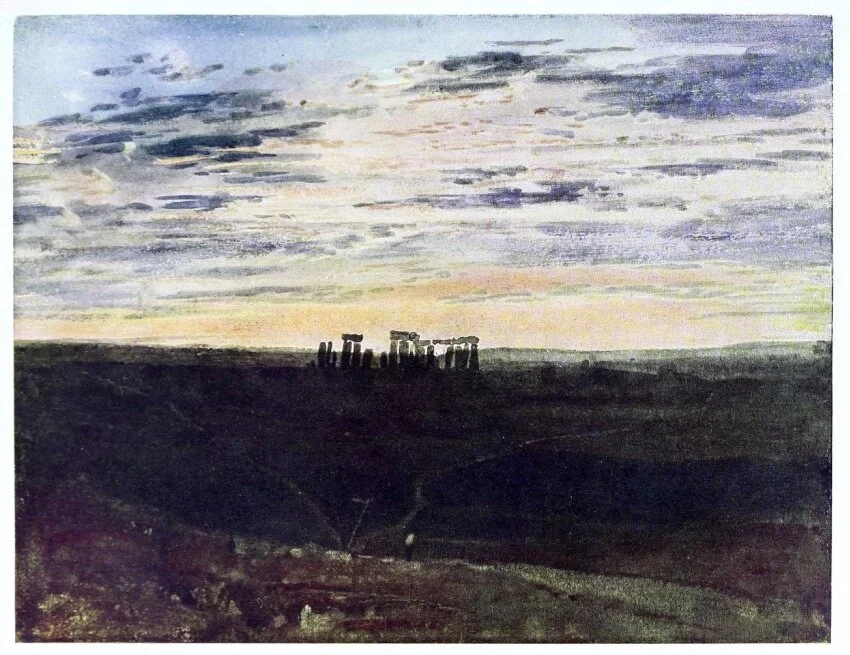
The lesser stonehenge - JMW Turner
Big Thief - "Mary"
From George Borrow's "Lavengro"
"What is your opinion of death, Mr Petulengro?" said I.
"My opinion of death, brother . . . is when a man dies, he is cast into the earth . . . and there is an end of the matter."
"And do you think that is the end of man?"
"There's an end to him, brother, more's the pity."
"Why do you say so?"
"Life is sweet, brother."
"Do you think so?"
"Think so! There's night and day, brother, both sweet things; sun, moon and stars, brother, all sweet things; there's likewise a wind in the heath. Life is very sweet, brother, who would wish to die?"
"I would wish to die . . ."
"You talk like a gorgio - which is the same thing as talking like a fool - were you a Romany Chal you would talk wiser. Wish to die, indeed, A Romany Chal would wish to live for ever."
"In sickness, Jasper?"
"There's the sun and stars, brother."
"In blindness, Jasper?"
"There's the wind on the heath, brother; if I could only feel that, I would gladly live for ever . . .”
The Beach Boys - "Feel Flows"
Things
What happened is, we grew lonely
living among the things,
so we gave the clock a face,
the chair a back,
the table four stout legs
which will never suffer fatigue.
We fitted our shoes with tongues
as smooth as our own
and hung tongues inside bells
so we could listen
to their emotional language,
and because we loved graceful profiles
the pitcher received a lip,
the bottle a long, slender neck.
Even what was beyond us
was recast in our image;
we gave the country a heart,
the storm an eye,
the cave a mouth
so we could pass into safety.
- Lisel Mueller
From Hebrews
“But without faith it is impossible to please him; for he that cometh to God must believe that he is, and that he is a rewarder of of them that diligently seek him.
By faith Noah, being warned of God of things not seen as yet, moved with fear, prepared an ark to the saving of his house; by the which he condemned the world, and became heir of the righteousness which is by faith.
By faith Abraham, when he was called to go out into a place which he should after receive for an inheritance, obeyed; and he went out, not knowing whither he went.
By faith he sojourned in the land of promise, as in a strange country, dwelling in tabernacles with Isaac and Jacob, the heirs with him of the same promise:
For he looked for a city which hath foundations, whose builder and maker is God.
Through faith also Sara herself received strength to conceive seed, and was delivered of a child when she was past age, because she judged him faithful who had promised.
Therefore sprang there even of one, and him as good as dead, so many as the stars of the sky in multitude, and as the sand which is by the sea shore innumerable.
These all died in faith, not having received the promises, but having seen them afar off, and were persuaded of them, and embraced them, and confessed that they were strangers and pilgrims on the earth.”
- Hebrews 11:6-13
The Life
Murdered, I went, risen,
Where the murderers are,
That black ditch
Of river.
And if I come back to my only country
With a white rose on my shoulder,
What is that to you?
It is the grave
in blossom.
It is the trillium of darkness,
It is hell, it is the beginning of winter,
It is a ghost town of Etruscans
Who have no names
Any more.
It is the old loneliness.
It is.
And it is
The last time.
- James Wright
From Paul's letter to Timothy
“Perverse disputings of men of corrupt minds, and destitute of the truth, supposing that gain is godliness: from such withdraw thyself.
But godliness with contentment is great gain.
For we brought nothing into this world, and it is certain we can carry nothing out.
And having food and raiment let us be therefore with content.”
- I Timothy, 5:5 - 5:8
